Puzzle products
Just as many polytopes (polygons, polyhedra, polychora, etc.) can be constructed from applying operations on other polytopes, twisty puzzles can also be constructed from other twisty puzzles.
Research in this area is ongoing, but we’ve already discovered one very powerful tool: the puzzle product, analogous to the prism product on polytopes. We’ll start with the formal definitions, then move into examples to illustrate how it works.
Background
Feel free to skip each section if you are already comfortable with the concept.
Cartesian product
The cartesian product of two sets \(A\) and \(B\) (written \(A \times B\)) is the set of all pairs \((a,b)\) where \(a \in A\) and \(b \in B\). For example, \(\{ x, y, z \} \times \{ 1, 2, 3 \}\) is illustrated below:

Disjoint union
The disjoint union of two sets \(A\) and \(B\) (written \(A \sqcup B\)) is the set of all the elements in \(A\) and all the elements in \(B\), with elements distinguished so every element in \(A \sqcup B\) is a member of only \(A\) or only \(B\). For example, notice how in the example below there are multiple copies of identical shapes, each labeled based on the set it come from:

Symmetry group
The symmetry group of an object is all the ways it can be transformed while remaining indistinguishable. The orientation of an object is whether it has been reflected.1 For our purposes, rotations are transformations that preserve the orientation, while reflections do not. For example, the symmetry-group regular pentagon has 5 rotations (including the trivial “rotation” that does nothing) and 5 reflections.
Another example: the symmetry group of the cube has 48 elements: 24 rotations (including the trivial “rotation” where it doesn’t move) and 24 reflections.
Puzzle construction
We will the Laminated Theory construction for puzzles. See the Slightly Wrong Explanation of Grip Theory if you haven’t yet. In particular, recall that:
- A puzzle is defined by a grip group \(G\), a set of layers \(L\) partitioned into axes \(A\), and a set of pieces \(P\).
- The grip group acts on the set of layers.
- The set of axes forms a block system for the action of the grip group on layers.
- A piece is defined by its grip signature, which is a subset of layers.
Definition
The puzzle product \(\alpha \times \beta\) of two factor puzzles \(\alpha\) and \(\beta\) is defined as follows:
- \(G_{\alpha \times \beta} = G_\alpha \times G_\beta\)
- \(A_{\alpha \times \beta} = A_\alpha \sqcup A_\beta\)
- \(L_{\alpha \times \beta} = L_\alpha \sqcup L_\beta\)
- \(P_{\alpha \times \beta} = P_\alpha \times P_\beta\)
It’s really that simple!
Of course, the pedantic among you will want to know how \(G_{\alpha \times \beta}\) acts on \(L_{\alpha \times \beta}\) and exactly what the grip signature is for each piece in \(P_{\alpha \times \beta}\):
- Given \(g_\alpha \in G_\alpha\), \(g_\beta \in G_\beta\), \(l_\alpha \in L_\alpha\), and \(l_\beta \in L_\beta\), then \((g_\alpha, g_\beta)(l_\alpha, l_\beta) = (g_\alpha l_\alpha, g_\beta l_\beta)\).
- \(P_{\alpha \times \beta} = \{ p_\alpha \sqcup p\beta \mid p_\alpha \in P_\alpha \ \mbox{ and } \ p_\beta \in P_\beta \}\).
Stickering
We typically sticker puzzles using stickers, which are partitioned into colors.
Colors are simple. If \(C\) is the set of colors on a puzzle, then \(C_{\alpha \times \beta} = C_\alpha \sqcup C_\beta\).
Stickers are more complicated. If \(S_p\) is the set of stickers for a piece \(p\), then \(S_{p_\alpha \times p_\beta} = S_{p_\alpha} \sqcup S_{p_\beta}\). In other words: the set of stickers for a piece in the product puzzle is the disjoint union of the stickers for each corresponding piece in the factor puzzles.
Example: canon-cut FT pentagonal prism
This will all be much clearer with an example. First, let’s define our factor puzzles:
3-layer line

- \(G\) = symmetries of a line (2 elements) = Coxeter group \(A_1\)
- \(A\) = 1 axis
- \(L\) = 3 layers
- \(P\) = 3 pieces
- 1 core with 0 stickers
- 2 endpoints with 1 sticker each
Shallow edge-turning pentagon
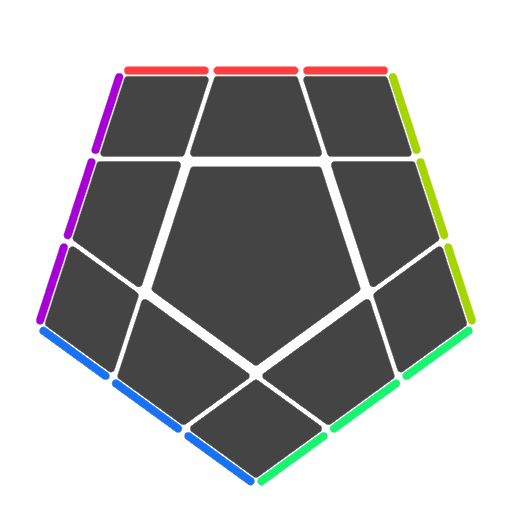
- \(G\) = symmetries of a pentagon (10 elements) = Coxeter group \(I_5\)
- \(A\) = 5 pentagon edges
- \(L\) = 10 layers (2 per axis)
- \(P\) = 11 pieces
- 1 core with 0 stickers
- 5 centers with 1 sticker each
- 5 corners with 2 stickers each
Now we can construct their product:
Canon-cut FT pentagonal prism
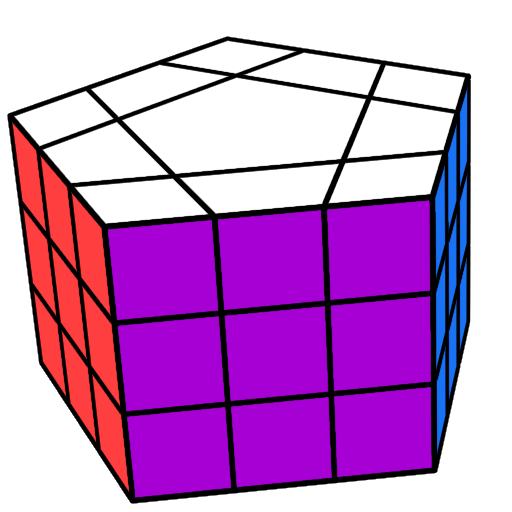
- \(G\) = symmetries of a pentagonal prism (20 elements) = Coxeter group \(I_5 \times A_1\)
- \(A\) = 6 axes (5 from the pentagon, 1 from the line)
- \(L\) = 13 layers (10 from the pentagon, 3 from the line)
- \(P\) = 33 pieces
| Piece type | Where it comes from | Stickers per piece |
|---|---|---|
| 1 core | 1 pentagon core \(\times\) 1 line core | 0 |
| 5 side centers | 5 pentagon centers \(\times\) 1 line core | 1 (1 from pentagon) |
| 5 side-side edges | 5 pentagon corners \(\times\) 1 line core | 2 (2 from pentagon) |
| 2 pentagon centers | 1 pentagon core \(\times\) 2 line endpoints | 1 (1 from line) |
| 10 pentagon-side edges | 5 pentagon centers \(\times\) 2 line endpoints | 2 (1 from pentagon + 1 from line) |
| 10 corners | 5 pentagon corners \(\times\) 2 line endpoints | 3 (2 from pentagon + 1 from line) |
Note that even though the core makes no difference for solving, we must include it in the factor puzzles in order to get the centers and middle layer pieces of the product.
The reflection problem
I lied to you. We have not actually constructed the standard canon-cut FT pentagonal prism. We have constructed the refle canon-cut FT pentagonal prism, which is exactly the same except that it allows reflection moves, like the “mirror & twist” reflecube.
If we remove the reflections from either of the factor puzzles then we lose the 180° twists on the rectangular side faces, because the 180° rotation is generated by composing the line reflection with a pentagon reflection. If we want to generate the rotational canon-cut FT pentagonal prism, which only allows rotations as twists, then we need to get more creative.
We could say that the FT pentagonal prism is the rotational subpuzzle of product of an ET pentagon with a 3-layer line, but there’s a few different ways to define “rotational subpuzzle.”
Option 1: Pick a different grip group
We could define the rotational subpuzzle of a puzzle as the puzzle with only the orientation-preserving elements of the grip group, and everything else the same. This works for our pentagonal prism example; however, it does not work for puzzles such as the Hemimegaminx and Klein Bottle Rubik, which are constructed in non-orientable spaces. The grip group for each of those puzzles has no subgroup we can choose that will contain only rotational twists.
Option 2: Add a twist subset
We could add a twist subset for the whole puzzle. This is a subset of possible twists that are actually allowed to be performed.
Then the rotational subpuzzle of a puzzle is simply one where the set of twists has had all the reflections removed. This works!
Option 3: Add axis subgroups
Alternatively, we could add an axis subgroup to each axis, which is a subgroup of the stabilizer of the axis in the grip group from which twists on that axis must be constructed. I.e., it’s some subgroup that keeps the axis fixed.
Then the rotational subpuzzle is the puzzle where all the axis subgroups have had reflections removed. This works!
Axis subgroups are also nice because they capture more structure than twist subsets: for example, they enforce that composing two twists on an axis always results in another twist.
New definition, using axis subgroups
Let’s use axis subgroups. Let \(H_a\) be the subgroup of an axis \(a\).
We can define the subgroup of a product axis \(H_{a_\alpha}\) in the product puzzle to be \(H_{a_\alpha} \times G_\beta\); likewise \(H_{a_\beta}\) in the product puzzle is \(G_\alpha \times H_{a_\beta}\).
-
A “non-orientable” shape is one where orientation cannot be determined. Typically this is because a reflection can be undone using only rotations. ↩