Conic Sweep Puzzle Sets
A polyhedral conic sweep set is a set of every distinct puzzle produced by cutting a solid with congruent, origin-centered cones whose axes are aligned to the face normals of a given polyhedron.
This article is meant to serve as a reference sheet detailing notable puzzle sets in full with their exact measurements and solutions. In practice, these solutions can provide exceptionally helpful literal guidelines when designing cutpaths for twisty puzzles.
Terminology
Note: Several of these terms were coined while writing this article and are only meant to aid in explanation. Most were adapted from existing mathematical terminology, such as “concurrence,” in an effort to make them intuitive and minimize unnecessary abstraction.
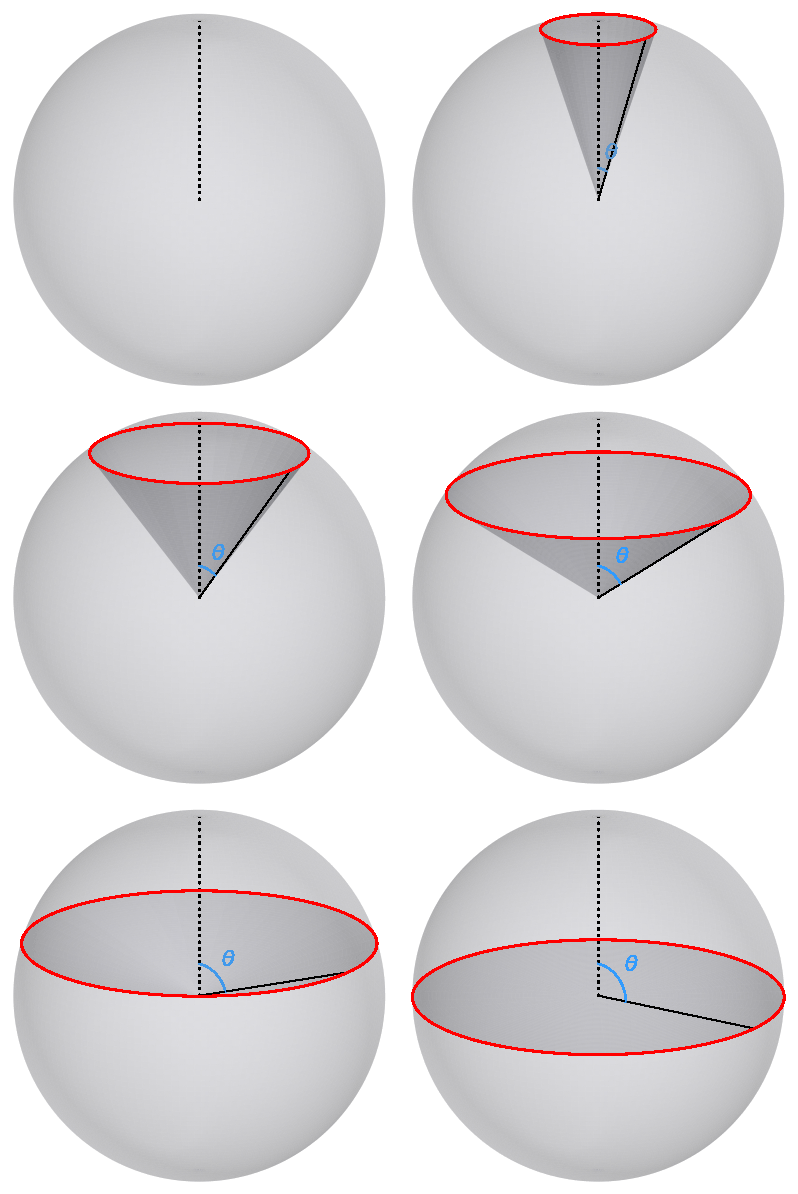
Trace line
A trace line is a curve formed by the intersection of a cone and the surface of a solid. In the case of a sphere (when centered at the origin), a trace line will always be circular, but with a different solid or polyhedron a trace line can be very curvy and sharp.
Puzzle
A puzzle is any result in a full conic sweep operation for a given polyhedron where \(0^\circ < \theta < 180^\circ\). The sets below exhibit every “unique” puzzle for their respective polyhedra so they only cover results in the range \(0^\circ < \theta \le 90^\circ\) because values past \(90^\circ\) only produce mirrored (non-unique) puzzles. Each set is composed of two alternating types of puzzles: a sweep over a range before an intersection known as a phase, or a static instance at a phase boundary.
Boundary/Intersection
A phase boundary or intersection occurs when two or more trace lines make contact in one of three ways:
— Tangency
When two trace lines meet at a point and share the same local direction at that point.
— Concurrence
When three or more non-tangent trace lines intersect at one common point.
— Coincidence
When two trace lines completely overlap (this only occurs when \(\theta = 90^\circ\)).
Catalog of Conic Sweep Sets
Platonic solids
The Platonic solids form a fundamental class of conic sweep sets. These sets often appear as recurring subsets within other polyhedral conic sweep sets, especially those associated with the Catalan and Archimedean solids.
Tetrahedral conic sweep set

The tetrahedral conic sweep set consists of five distinct constructions. Uniquely, the tetrahedron is the only Platonic solid that does not end with a coincident intersection due to its lack of opposing faces. It is the only set that never crosses the center point of its faces. This group contains only two trace-line intersections, one tangent and the other concurrent.
| Step | Phase | Boundary / Intersection |
Image | Cone Angle \(\theta\) |
Sweep Progress (\(s = \theta/90^\circ\)) |
Type |
|---|---|---|---|---|---|---|
| 1 | 1 | NA |  |
\(\displaystyle \{\)\(\displaystyle 0^\circ\)\(\displaystyle < \theta <\)\(\displaystyle \cos^{-1}\!\left(\dfrac{1}{\sqrt{3}}\right)\)\(\displaystyle \}\)\(\displaystyle \{\)\(\displaystyle 0^\circ\)\(\displaystyle < \theta <\)\(\displaystyle \mathord{\sim}54.736^\circ\)\(\displaystyle \}\) | \(\displaystyle \left\{0\% < s < \mathord{\sim}60.8\%\right\}\) | NA |
| 2 | NA | 1 |  |
\(\displaystyle \cos^{-1}\!\left(\dfrac{1}{\sqrt{3}}\right)\)\(\displaystyle \mathord{\sim}54.736^\circ\) | \(\displaystyle \mathord{\sim}60.8\%\) | Tangent |
| 3 | 2 | NA |  |
\(\displaystyle \{\)\(\displaystyle \cos^{-1}\!\left(\dfrac{1}{\sqrt{3}}\right)\)\(\displaystyle < \theta <\)\(\displaystyle \cos^{-1}\!\left(\dfrac{1}{3}\right)\)\(\displaystyle \}\)\(\displaystyle \{\)\(\displaystyle \mathord{\sim}54.736^\circ\)\(\displaystyle < \theta <\)\(\displaystyle \mathord{\sim}70.529^\circ\)\(\displaystyle \}\) | \(\displaystyle \left\{\mathord{\sim}60.8\% < s < \mathord{\sim}78.4\%\right\}\) | NA |
| 4 | NA | 2 |  |
\(\displaystyle \cos^{-1}\!\left(\dfrac{1}{3}\right)\)\(\displaystyle \mathord{\sim}70.529^\circ\) | \(\displaystyle \mathord{\sim}78.4\%\) | Concurrent |
| 5 | 3 | NA |  |
\(\displaystyle \{\)\(\displaystyle \cos^{-1}\!\left(\dfrac{1}{3}\right)\)\(\displaystyle < \theta \le\)\(\displaystyle 90^\circ\)\(\displaystyle \}\)\(\displaystyle \{\)\(\displaystyle \mathord{\sim}70.529^\circ\)\(\displaystyle < \theta \le\)\(\displaystyle 90^\circ\)\(\displaystyle \}\) | \(\displaystyle \left\{\mathord{\sim}78.4\% < s \le 100\%\right\}\) | NA |
Hexahedral conic sweep set

The hexahedral conic sweep set consists of six distinct constructions. This group contains three trace-line intersections: 1 tangent, 1 concurrent, and 1 coincident.
| Step | Phase | Boundary / Intersection |
Image | Cone Angle \(\theta\) |
Sweep Progress (\(s = \theta/90^\circ\)) |
Type |
|---|---|---|---|---|---|---|
| 1 | 1 | NA |  |
\(\displaystyle \{\)\(\displaystyle 0^\circ\)\(\displaystyle < \theta \lt\)\(\displaystyle 45^\circ\)\(\displaystyle \}\)\(\displaystyle \{\)\(\displaystyle 0^\circ\)\(\displaystyle < \theta \lt\)\(\displaystyle 45.000^\circ\)\(\displaystyle \}\) | \(\displaystyle \left\{0\% < s \lt 50.0\%\right\}\) | NA |
| 2 | NA | 1 |  |
\(\displaystyle 45^\circ\)\(\displaystyle 45.000^\circ\) | \(\displaystyle 50.0\%\) | Tangent |
| 3 | 2 | NA |  |
\(\displaystyle \{\)\(\displaystyle 45^\circ\)\(\displaystyle \lt \theta \lt\)\(\displaystyle \cos^{-1}\!\left(\dfrac{1}{\sqrt{3}}\right)\)\(\displaystyle \}\)\(\displaystyle \{\)\(\displaystyle 45.000^\circ\)\(\displaystyle \lt \theta \lt\)\(\displaystyle \mathord{\sim}54.736^\circ\)\(\displaystyle \}\) | \(\displaystyle \left\{50.0\% \lt s \lt \mathord{\sim}60.8\%\right\}\) | NA |
| 4 | NA | 2 |  |
\(\displaystyle \cos^{-1}\!\left(\dfrac{1}{\sqrt{3}}\right)\)\(\displaystyle \mathord{\sim}54.736^\circ\) | \(\displaystyle \mathord{\sim}60.8\%\) | Concurrent |
| 5 | 3 | NA |  |
\(\displaystyle \{\)\(\displaystyle \cos^{-1}\!\left(\dfrac{1}{\sqrt{3}}\right)\)\(\displaystyle \lt \theta \lt\)\(\displaystyle 90^\circ\)\(\displaystyle \}\)\(\displaystyle \{\)\(\displaystyle \mathord{\sim}54.736^\circ\)\(\displaystyle \lt \theta \lt\)\(\displaystyle 90.000^\circ\)\(\displaystyle \}\) | \(\displaystyle \left\{\mathord{\sim}60.8\% \lt s \lt 100\%\right\}\) | NA |
| 6 | NA | 3 |  |
\(\displaystyle 90^\circ\)\(\displaystyle 90.000^\circ\) | \(\displaystyle 100\%\) | Coincident |
Octahedral conic sweep set

The octahedral conic sweep set consists of eight distinct constructions. This group contains four trace-line intersections: 2 tangent, 1 concurrent, and 1 coincident.
| Step | Phase | Boundary / Intersection |
Image | Cone Angle \(\theta\) |
Sweep Progress (\(s = \theta/90^\circ\)) |
Type |
|---|---|---|---|---|---|---|
| 1 | 1 | NA |  |
\(\displaystyle \{\)\(\displaystyle 0^\circ\)\(\displaystyle < \theta \lt\)\(\displaystyle \cos^{-1}\!\left(\dfrac{2}{\sqrt{6}}\right)\)\(\displaystyle \}\)\(\displaystyle \{\)\(\displaystyle 0^\circ\)\(\displaystyle < \theta \lt\)\(\displaystyle \mathord{\sim}35.264^\circ\)\(\displaystyle \}\) | \(\displaystyle \left\{0\% < s \lt \mathord{\sim}39.2\%\right\}\) | NA |
| 2 | NA | 1 |  |
\(\displaystyle \cos^{-1}\!\left(\dfrac{2}{\sqrt{6}}\right)\)\(\displaystyle \mathord{\sim}35.264^\circ\) | \(\displaystyle \mathord{\sim}39.2\%\) | Tangent |
| 3 | 2 | NA |  |
\(\displaystyle \{\)\(\displaystyle \cos^{-1}\!\left(\dfrac{2}{\sqrt{6}}\right)\)\(\displaystyle \lt \theta \lt\)\(\displaystyle \cos^{-1}\!\left(\dfrac{1}{\sqrt{3}}\right)\)\(\displaystyle \}\)\(\displaystyle \{\)\(\displaystyle \mathord{\sim}35.264^\circ\)\(\displaystyle \lt \theta \lt\)\(\displaystyle \mathord{\sim}54.736^\circ\)\(\displaystyle \}\) | \(\displaystyle \left\{\mathord{\sim}39.2\% \lt s \lt \mathord{\sim}60.8\%\right\}\) | NA |
| 4 | NA | 2 |  |
\(\displaystyle \cos^{-1}\!\left(\dfrac{1}{\sqrt{3}}\right)\)\(\displaystyle \mathord{\sim}54.736^\circ\) | \(\displaystyle \mathord{\sim}60.8\%\) | Tangent |
| 5 | 3 | NA |  |
\(\displaystyle \{\)\(\displaystyle \cos^{-1}\!\left(\dfrac{1}{\sqrt{3}}\right)\)\(\displaystyle \lt \theta \lt\)\(\displaystyle \cos^{-1}\!\left(\dfrac{1}{3}\right)\)\(\displaystyle \}\)\(\displaystyle \{\)\(\displaystyle \mathord{\sim}54.736^\circ\)\(\displaystyle \lt \theta \lt\)\(\displaystyle \mathord{\sim}70.529^\circ\)\(\displaystyle \}\) | \(\displaystyle \left\{\mathord{\sim}60.8\% \lt s \lt \mathord{\sim}78.4\%\right\}\) | NA |
| 6 | NA | 3 |  |
\(\displaystyle \cos^{-1}\!\left(\dfrac{1}{3}\right)\)\(\displaystyle \mathord{\sim}70.529^\circ\) | \(\displaystyle \mathord{\sim}78.4\%\) | Concurrent |
| 7 | 4 | NA |  |
\(\displaystyle \{\)\(\displaystyle \cos^{-1}\!\left(\dfrac{1}{3}\right)\)\(\displaystyle \lt \theta \lt\)\(\displaystyle 90^\circ\)\(\displaystyle \}\)\(\displaystyle \{\)\(\displaystyle \mathord{\sim}70.529^\circ\)\(\displaystyle \lt \theta \lt\)\(\displaystyle 90.000^\circ\)\(\displaystyle \}\) | \(\displaystyle \left\{\mathord{\sim}78.4\% \lt s \lt 100\%\right\}\) | NA |
| 8 | NA | 4 |  |
\(\displaystyle 90^\circ\)\(\displaystyle 90.000^\circ\) | \(\displaystyle 100\%\) | Coincident |
Dodecahedral conic sweep set

The dodecahedral conic sweep set consists of 12 distinct constructions. This group contains six trace-line intersections: 2 tangent, 3 concurrent, and 1 coincident.
| Step | Phase | Boundary / Intersection |
Image | Cone Angle \(\theta\) |
Sweep Progress (\(s = \theta/90^\circ\)) |
Type |
|---|---|---|---|---|---|---|
| 1 | 1 | NA |  |
\(\displaystyle \{\)\(\displaystyle 0^\circ\)\(\displaystyle < \theta \lt\)\(\displaystyle \cos^{-1}\!\left(\sqrt{\dfrac{5+\sqrt{5}}{10}}\right)\)\(\displaystyle \}\)\(\displaystyle \{\)\(\displaystyle 0^\circ\)\(\displaystyle < \theta \lt\)\(\displaystyle \mathord{\sim}31.717^\circ\)\(\displaystyle \}\) | \(\displaystyle \left\{0\% < s \lt \mathord{\sim}35.2\%\right\}\) | NA |
| 2 | NA | 1 |  |
\(\displaystyle \cos^{-1}\!\left(\sqrt{\dfrac{5+\sqrt{5}}{10}}\right)\)\(\displaystyle \mathord{\sim}31.717^\circ\) | \(\displaystyle \mathord{\sim}35.2\%\) | Tangent |
| 3 | 2 | NA |  |
\(\displaystyle \{\)\(\displaystyle \cos^{-1}\!\left(\sqrt{\dfrac{5+\sqrt{5}}{10}}\right)\)\(\displaystyle \lt \theta \lt\)\(\displaystyle \cos^{-1}\!\left(\sqrt{\dfrac{5+2\sqrt{5}}{15}}\right)\)\(\displaystyle \}\)\(\displaystyle \{\)\(\displaystyle \mathord{\sim}31.717^\circ\)\(\displaystyle \lt \theta \lt\)\(\displaystyle \mathord{\sim}37.377^\circ\)\(\displaystyle \}\) | \(\displaystyle \left\{\mathord{\sim}35.2\% \lt s \lt \mathord{\sim}41.5\%\right\}\) | NA |
| 4 | NA | 2 |  |
\(\displaystyle \cos^{-1}\!\left(\sqrt{\dfrac{5+2\sqrt{5}}{15}}\right)\)\(\displaystyle \mathord{\sim}37.377^\circ\) | \(\displaystyle \mathord{\sim}41.5\%\) | Concurrent |
| 5 | 3 | NA |  |
\(\displaystyle \{\)\(\displaystyle \cos^{-1}\!\left(\sqrt{\dfrac{5+2\sqrt{5}}{15}}\right)\)\(\displaystyle \lt \theta \lt\)\(\displaystyle \cos^{-1}\!\left(\sqrt{\dfrac{5-\sqrt{5}}{10}}\right)\)\(\displaystyle \}\)\(\displaystyle \{\)\(\displaystyle \mathord{\sim}37.377^\circ\)\(\displaystyle \lt \theta \lt\)\(\displaystyle \mathord{\sim}58.283^\circ\)\(\displaystyle \}\) | \(\displaystyle \left\{\mathord{\sim}41.5\% \lt s \lt \mathord{\sim}64.8\%\right\}\) | NA |
| 6 | NA | 3 |  |
\(\displaystyle \cos^{-1}\!\left(\sqrt{\dfrac{5-\sqrt{5}}{10}}\right)\)\(\displaystyle \mathord{\sim}58.283^\circ\) | \(\displaystyle \mathord{\sim}64.8\%\) | Tangent |
| 7 | 4 | NA |  |
\(\displaystyle \{\)\(\displaystyle \cos^{-1}\!\left(\sqrt{\dfrac{5-\sqrt{5}}{10}}\right)\)\(\displaystyle \lt \theta \lt\)\(\displaystyle \cos^{-1}\!\left(\dfrac{1}{\sqrt{5}}\right)\)\(\displaystyle \}\)\(\displaystyle \{\)\(\displaystyle \mathord{\sim}58.283^\circ\)\(\displaystyle \lt \theta \lt\)\(\displaystyle \mathord{\sim}63.435^\circ\)\(\displaystyle \}\) | \(\displaystyle \left\{\mathord{\sim}64.8\% \lt s \lt \mathord{\sim}70.5\%\right\}\) | NA |
| 8 | NA | 4 |  |
\(\displaystyle \cos^{-1}\!\left(\dfrac{1}{\sqrt{5}}\right)\)\(\displaystyle \mathord{\sim}63.435^\circ\) | \(\displaystyle \mathord{\sim}70.5\%\) | Concurrent |
| 9 | 5 | NA |  |
\(\displaystyle \{\)\(\displaystyle \cos^{-1}\!\left(\dfrac{1}{\sqrt{5}}\right)\)\(\displaystyle \lt \theta \lt\)\(\displaystyle \cos^{-1}\!\left(\sqrt{\dfrac{5-2\sqrt{5}}{15}}\right)\)\(\displaystyle \}\)\(\displaystyle \{\)\(\displaystyle \mathord{\sim}63.435^\circ\)\(\displaystyle \lt \theta \lt\)\(\displaystyle \mathord{\sim}79.188^\circ\)\(\displaystyle \}\) | \(\displaystyle \left\{\mathord{\sim}70.5\% \lt s \lt \mathord{\sim}88.0\%\right\}\) | NA |
| 10 | NA | 5 |  |
\(\displaystyle \cos^{-1}\!\left(\sqrt{\dfrac{5-2\sqrt{5}}{15}}\right)\)\(\displaystyle \mathord{\sim}79.188^\circ\) | \(\displaystyle \mathord{\sim}88.0\%\) | Concurrent |
| 11 | 6 | NA |  |
\(\displaystyle \{\)\(\displaystyle \cos^{-1}\!\left(\sqrt{\dfrac{5-2\sqrt{5}}{15}}\right)\)\(\displaystyle \lt \theta \lt\)\(\displaystyle 90^\circ\)\(\displaystyle \}\)\(\displaystyle \{\)\(\displaystyle \mathord{\sim}79.188^\circ\)\(\displaystyle \lt \theta \lt\)\(\displaystyle 90.000^\circ\)\(\displaystyle \}\) | \(\displaystyle \left\{\mathord{\sim}88.0\% \lt s \lt 100\%\right\}\) | NA |
| 12 | NA | 6 |  |
\(\displaystyle 90^\circ\)\(\displaystyle 90.000^\circ\) | \(\displaystyle 100\%\) | Coincident |
Icosahedral conic sweep set

The icosahedral conic sweep set consists of 24 distinct constructions. This group contains 12 trace-line intersections: 4 tangent, 7 concurrent, and 1 coincident.
| Step | Phase | Boundary / Intersection |
Image | Cone Angle \(\theta\) |
Sweep Progress (\(s = \theta/90^\circ\)) |
Type |
|---|---|---|---|---|---|---|
| 1 | 1 | NA |  |
\(\displaystyle \{\)\(\displaystyle 0^\circ\)\(\displaystyle < \theta \lt\)\(\displaystyle \cos^{-1}\!\left(\dfrac{\sqrt{15}+\sqrt{3}}{6}\right)\)\(\displaystyle \}\)\(\displaystyle \{\)\(\displaystyle 0^\circ\)\(\displaystyle < \theta \lt\)\(\displaystyle \mathord{\sim}20.905^\circ\)\(\displaystyle \}\) | \(\displaystyle \left\{0\% < s \lt \mathord{\sim}23.2\%\right\}\) | NA |
| 2 | NA | 1 |  |
\(\displaystyle \cos^{-1}\!\left(\dfrac{\sqrt{15}+\sqrt{3}}{6}\right)\)\(\displaystyle \mathord{\sim}20.905^\circ\) | \(\displaystyle \mathord{\sim}23.2\%\) | Tangent |
| 3 | 2 | NA |  |
\(\displaystyle \{\)\(\displaystyle \cos^{-1}\!\left(\dfrac{\sqrt{15}+\sqrt{3}}{6}\right)\)\(\displaystyle \lt \theta \lt\)\(\displaystyle \cos^{-1}\!\left(\dfrac{2}{\sqrt{6}}\right)\)\(\displaystyle \}\)\(\displaystyle \{\)\(\displaystyle \mathord{\sim}20.905^\circ\)\(\displaystyle \lt \theta \lt\)\(\displaystyle \mathord{\sim}35.264^\circ\)\(\displaystyle \}\) | \(\displaystyle \left\{\mathord{\sim}23.2\% \lt s \lt \mathord{\sim}39.2\%\right\}\) | NA |
| 4 | NA | 2 |  |
\(\displaystyle \cos^{-1}\!\left(\dfrac{2}{\sqrt{6}}\right)\)\(\displaystyle \mathord{\sim}35.264^\circ\) | \(\displaystyle \mathord{\sim}39.2\%\) | Tangent |
| 5 | 3 | NA |  |
\(\displaystyle \{\)\(\displaystyle \cos^{-1}\!\left(\dfrac{2}{\sqrt{6}}\right)\)\(\displaystyle \lt \theta \lt\)\(\displaystyle \cos^{-1}\!\left(\sqrt{\dfrac{5+2\sqrt{5}}{15}}\right)\)\(\displaystyle \}\)\(\displaystyle \{\)\(\displaystyle \mathord{\sim}35.264^\circ\)\(\displaystyle \lt \theta \lt\)\(\displaystyle \mathord{\sim}37.377^\circ\)\(\displaystyle \}\) | \(\displaystyle \left\{\mathord{\sim}39.2\% \lt s \lt \mathord{\sim}41.5\%\right\}\) | NA |
| 6 | NA | 3 |  |
\(\displaystyle \cos^{-1}\!\left(\sqrt{\dfrac{5+2\sqrt{5}}{15}}\right)\)\(\displaystyle \mathord{\sim}37.377^\circ\) | \(\displaystyle \mathord{\sim}41.5\%\) | Concurrent |
| 7 | 4 | NA |  |
\(\displaystyle \{\)\(\displaystyle \cos^{-1}\!\left(\sqrt{\dfrac{5+2\sqrt{5}}{15}}\right)\)\(\displaystyle \lt \theta \lt\)\(\displaystyle \cos^{-1}\!\left(\dfrac{\sqrt{5}}{3}\right)\)\(\displaystyle \}\)\(\displaystyle \{\)\(\displaystyle \mathord{\sim}37.377^\circ\)\(\displaystyle \lt \theta \lt\)\(\displaystyle \mathord{\sim}41.810^\circ\)\(\displaystyle \}\) | \(\displaystyle \left\{\mathord{\sim}41.5\% \lt s \lt \mathord{\sim}46.5\%\right\}\) | NA |
| 8 | NA | 4 |  |
\(\displaystyle \cos^{-1}\!\left(\dfrac{\sqrt{5}}{3}\right)\)\(\displaystyle \mathord{\sim}41.810^\circ\) | \(\displaystyle \mathord{\sim}46.5\%\) | Concurrent |
| 9 | 5 | NA |  |
\(\displaystyle \{\)\(\displaystyle \cos^{-1}\!\left(\dfrac{\sqrt{5}}{3}\right)\)\(\displaystyle \lt \theta \lt\)\(\displaystyle \cos^{-1}\!\left(\dfrac{1}{\sqrt{3}}\right)\)\(\displaystyle \}\)\(\displaystyle \{\)\(\displaystyle \mathord{\sim}41.810^\circ\)\(\displaystyle \lt \theta \lt\)\(\displaystyle \mathord{\sim}54.736^\circ\)\(\displaystyle \}\) | \(\displaystyle \left\{\mathord{\sim}46.5\% \lt s \lt \mathord{\sim}60.8\%\right\}\) | NA |
| 10 | NA | 5 |  |
\(\displaystyle \cos^{-1}\!\left(\dfrac{1}{\sqrt{3}}\right)\)\(\displaystyle \mathord{\sim}54.736^\circ\) | \(\displaystyle \mathord{\sim}60.8\%\) | Tangent |
| 11 | 6 | NA |  |
\(\displaystyle \{\)\(\displaystyle \cos^{-1}\!\left(\dfrac{1}{\sqrt{3}}\right)\)\(\displaystyle \lt \theta \lt\)\(\displaystyle \cos^{-1}\!\left(\sqrt{\dfrac{19+8\sqrt{5}}{123}}\right)\)\(\displaystyle \}\)\(\displaystyle \{\)\(\displaystyle \mathord{\sim}54.736^\circ\)\(\displaystyle \lt \theta \lt\)\(\displaystyle \mathord{\sim}56.795^\circ\)\(\displaystyle \}\) | \(\displaystyle \left\{\mathord{\sim}60.8\% \lt s \lt \mathord{\sim}63.1\%\right\}\) | NA |
| 12 | NA | 6 |  |
\(\displaystyle \cos^{-1}\!\left(\sqrt{\dfrac{19+8\sqrt{5}}{123}}\right)\)\(\displaystyle \mathord{\sim}56.795^\circ\) | \(\displaystyle \mathord{\sim}63.1\%\) | Concurrent |
| 13 | 7 | NA |  |
\(\displaystyle \{\)\(\displaystyle \cos^{-1}\!\left(\sqrt{\dfrac{19+8\sqrt{5}}{123}}\right)\)\(\displaystyle \lt \theta \lt\)\(\displaystyle \cos^{-1}\!\left(\sqrt{\dfrac{5}{21}}\right)\)\(\displaystyle \}\)\(\displaystyle \{\)\(\displaystyle \mathord{\sim}56.795^\circ\)\(\displaystyle \lt \theta \lt\)\(\displaystyle \mathord{\sim}60.794^\circ\)\(\displaystyle \}\) | \(\displaystyle \left\{\mathord{\sim}63.1\% \lt s \lt \mathord{\sim}67.5\%\right\}\) | NA |
| 14 | NA | 7 |  |
\(\displaystyle \cos^{-1}\!\left(\sqrt{\dfrac{5}{21}}\right)\)\(\displaystyle \mathord{\sim}60.794^\circ\) | \(\displaystyle \mathord{\sim}67.5\%\) | Concurrent |
| 15 | 8 | NA |  |
\(\displaystyle \{\)\(\displaystyle \cos^{-1}\!\left(\sqrt{\dfrac{5}{21}}\right)\)\(\displaystyle \lt \theta \lt\)\(\displaystyle \cos^{-1}\!\left(\dfrac{\sqrt{15}-\sqrt{3}}{6}\right)\)\(\displaystyle \}\)\(\displaystyle \{\)\(\displaystyle \mathord{\sim}60.794^\circ\)\(\displaystyle \lt \theta \lt\)\(\displaystyle \mathord{\sim}69.095^\circ\)\(\displaystyle \}\) | \(\displaystyle \left\{\mathord{\sim}67.5\% \lt s \lt \mathord{\sim}76.8\%\right\}\) | NA |
| 16 | NA | 8 |  |
\(\displaystyle \cos^{-1}\!\left(\dfrac{\sqrt{15}-\sqrt{3}}{6}\right)\)\(\displaystyle \mathord{\sim}69.095^\circ\) | \(\displaystyle \mathord{\sim}76.8\%\) | Tangent |
| 17 | 9 | NA |  |
\(\displaystyle \{\)\(\displaystyle \cos^{-1}\!\left(\dfrac{\sqrt{15}-\sqrt{3}}{6}\right)\)\(\displaystyle \lt \theta \lt\)\(\displaystyle \cos^{-1}\!\left(\dfrac{1}{3}\right)\)\(\displaystyle \}\)\(\displaystyle \{\)\(\displaystyle \mathord{\sim}69.095^\circ\)\(\displaystyle \lt \theta \lt\)<span class=”c… (9 KB left) |